
G-2: These two letters have just reshaping the balance of power in Asia, as America and China are now a group of two. The question arises, “What happens to the rest of the world?” Particularly India, Japan, and Australia. At the summit in Busan, Trump called it a great meeting of both “our countries”. He announced a sweeping truce in China. More importantly, the idea for BRICS was to de-dollarize the whole economical market pertaining in which the giants like Russia, India, Brazil and China came across partners around the globe showing faith in China because Russia and India was always on a similar note.
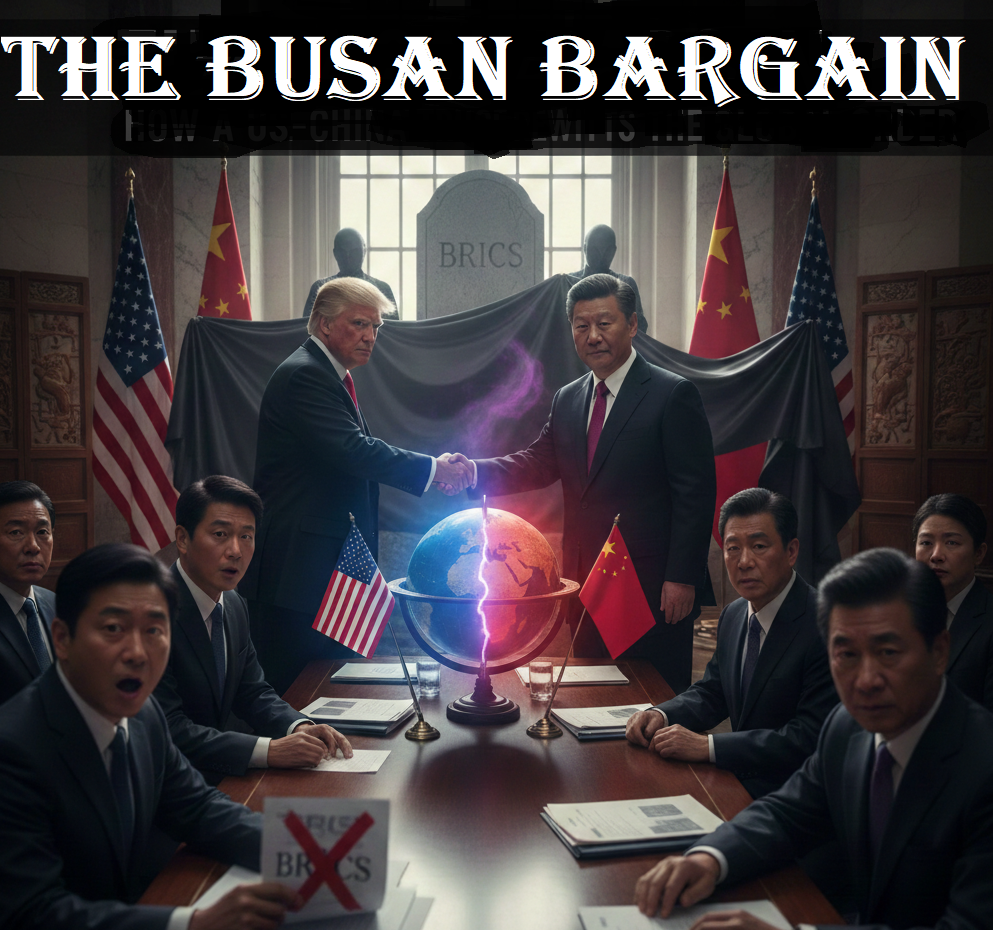
The founding pillar of the G2 was not led by Donald Trump. It was first brought in the late 2000s, which is basically the idea that the world’s future could be managed and lead by two giant countries. Washington and Beijing will decide what the universal rules of engagement are. In 1990s after the collapse of the Soviet Union the Asian front of industrialization and export was led by China. Eventually, us tried collaborating and developing major new industrial zones in Asia like Taiwan, Cambodia, Thailand and somewhat Philippines but the dedicated leadership which was aristocracy made China and economic superpower without human rights.
DC to Beijing
Every American President from Bill Clinton to Barack Obama and even Trump 1.0 circumvented a G-2 because the G-2 means one thing that everybody else becomes secondary and subordinate. Bill Clinton pushed for engagement, but he emphasized further alliance in Asia. George W. Bush expanded ties with both Japan and India, even as he fought wars in Afghanistan and Iraq. American and Chinese collaboration was mainly manipulated by Henry Kissinger and even before that in 1971 through ping pong diplomacy but like Trump 2.0 their angles would have also been not thought to make China as a partner for economic collaboration in the world.
Barack Obama made the point to Asia, which was especially to prevent China from governing the region. Even Trump, in his first term, in spite of all the disorder around it, was defined by tariffs and conflict with China, not collaboration and yet here we are in Trump 2.0, witnessing the American president speak of China not as a contender but as a companion in determining global peace. This is not just a diplomatic relaxation. This is a strategic move, one that gestures to the rest of the world that America no longer sees itself as the leader of the Indo-Pacific but as one half of a new global duopoly.
What changes for China?
Tariffs on Chinese goods will be cut by 10% which means it goes down to 47%. Beijing would resume buying American soybeans and Sorghum, and perhaps most significantly, both sides agreed to reopen direct military-to-military communication channels.
The kind of military channels that had gone cold since the Cold War. On paper, it looked like a triumph for stability, but underneath all the smiles and the friendliness was a much colder and much dangerous reality. For the very first time in decades, a sitting US President has overtly accredited China as an equal, not a competitor but a peer. For Xi Jinping paybacks are obvious; for years, Beijing has desired Washington to treat it as an equivalent and not as a challenge, and now Trump has delivered exactly that. Trump has given China and its leader the legitimacy that they have sought.
What changes for America?
The question arises, why has Trump, in his second term, embraced the idea of a G-2 so enthusiastically? One of the major reasons is fiscal fatigue. The trade war with China has maltreated American farmers, American industries, and supply chains. Trump wants a win. He wants a restoration of America’s exports to China. Part of it is also geopolitical intention. He wants to end America’s limitless commitments around the world and instead cut a grand bargain with the one country that is powerful enough to challenge America.
What changes for India?
For the last two decades, India’s grand policy has been to partner with America and other democracies to contain China’s rise. The US-India relationship, the Indo-Pacific strategies, and the Quad, all of these were constructed on a simple hypothesis that America would stay committed to containing Chinese dominance in Asia. But if Washington is now accepting Beijing as an equal, as a peer and not as a rival, then the entire basis begins to crash. India’s leverage deteriorates. Its role as a regional balance shrinks, and its hard-fought position at the international high table looks a little less sheltered.
By G-2, if the world’s two biggest powers now plot to manage the systems together, then smaller allies become by standards. They no longer help shape the rules instead Washington and Beijing make the rules, and the rest of Asia just has to obey them.
The outlines of a new global order are already obvious. Washington and Beijing have publicized joint working groups on trade, on rare-earth on tech supply chains. They have agreed to open defence hotlines and even considered joint anti-piracy drills. In the meantime, regional agendas like the Indo-Pacific and Quad, which once symbolised an accord against Chinese hegemony, are now starting to look shelved. Japan and Australia are deepening their ties with India on their own, despite America. Everyone is watching and wondering whether America, which has long promised a free and open Indo-Pacific, has just silently traded that away to China because a true G-2, a group of two between America and China, doesn’t mean world peace. It means power concentrated in two capitals, while everyone lives with the consequences of that. On ending note, again the question arises, do Asia need a formal organization to keep every concerns on table?

G2 might threat all the major asian alliance especially BRICS.. truly an alarming situation for India. Great analysis tho👏🏼
The article reflects the current political scenario, based on the position of two powerful nations and their future aspirations. The article highlights the context of the US-China relationship and their dominance and power on the global front, alongside the impact on Indian diplomacy and other Asian countries.
The context of the article should deal more with the cultural, religious and colonial histories of both the nations, with their origins from colonial histories to “Marxist, atheist state standing in opposition to a profoundly religious, staunchly anti-communist nation” and then a techno-utopian visionary like US is somewhat believing with a rise with positioning of religion at a different side in their constitutional structure, then the Opium wars to WTO regime and silicon valley issues. Many more events in history with Cold War or Taiwan issues, but all falling in modern times in the “elitist structure” for economic models of the nations.
As we advance with the contrast between “Mao Zedong and Donald Trump at the outset of his first administration, emphasizing key similarities between the two autocrats”, wherein one is the CCP Chairman and the other as Chairman of the Board as a businessman, both having their extreme nature of authoritarian position, knowingly for “polemical excess”. It’s the same ethos of Xi Jinping’s “politically authoritarian, socially conservative, and techno-nationalist vision and the governance principles of the ‘Make America Great Again’ (MAGA) doctrine” which were not visible in Chinese media or their policy, despite the opposing Western European notions of colonial imperialism, they take the US to be different from west because of ostensibly anti-Western but not anti-American.
While in conclusion, the methods of reach differing but both nations, China and the United States, show their impact of “sense of exceptionalism and universal ambition”, supporting each other, and that’s why the new shift in relationships is visible.