
In much of the world, Gen Z is seen as secular, globally oriented and eager to discard inherited norms. But in India, a different story is emerging. Instead of drifting away from tradition, many young Indians are turning toward it not in temples or classrooms, but on their phones. And while this revival appears harmless, even charming, its implications may be more complicated. Across India’s digital spaces, tradition has become a kind of currency: visually enticing, emotionally charged and endlessly shareable. Regional-language influencers surge in popularity. Devotional music dominates Instagram Reels. Astrology channels, cultural explainers and festival vlogs flourish. Tradition, recast as entertainment, spreads faster online than ever before.
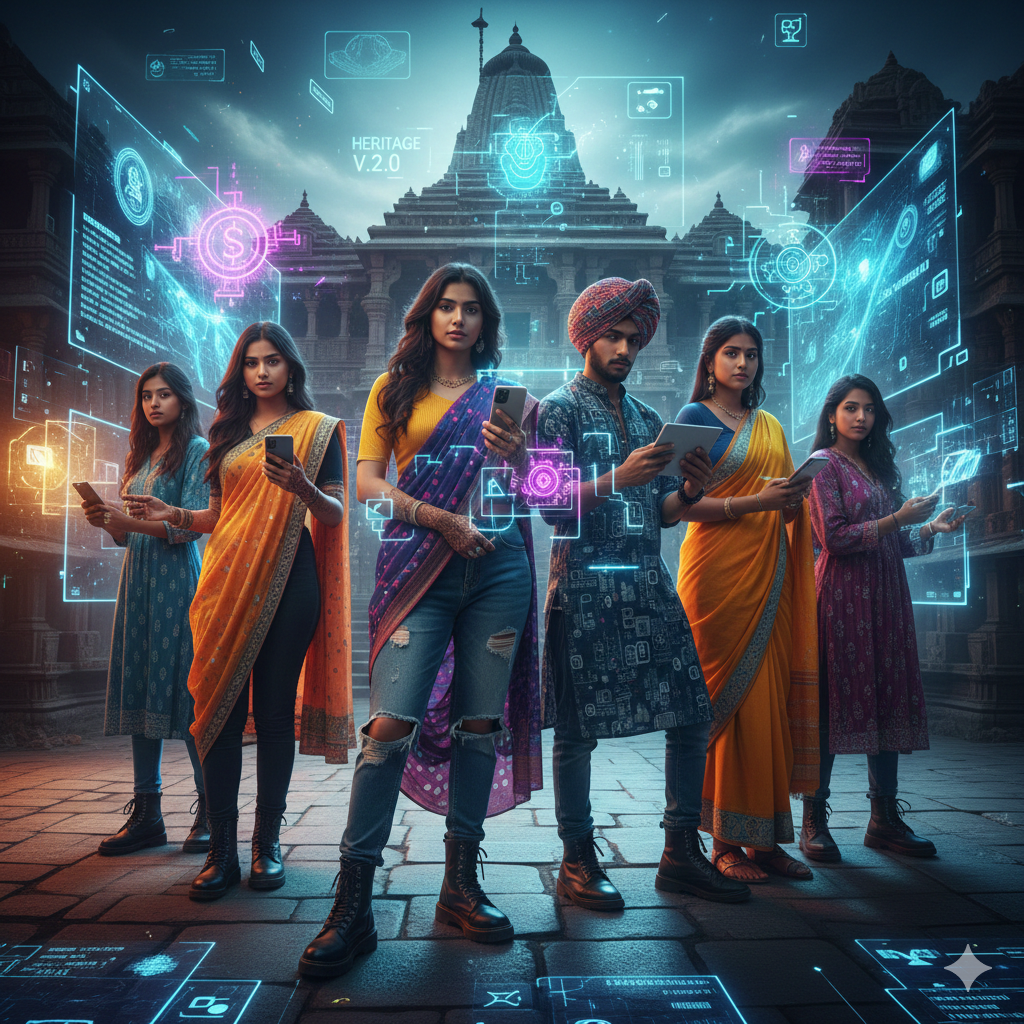
But beneath this aesthetic renaissance lies a quieter, more unsettling shift. The digital ecosystem which elsewhere loosens the grip of old hierarchies appears in India to be reinforcing them.This stands in sharp contrast to countries like the United States, Japan or South Korea, where younger generations are distancing themselves from religious institutions and rigid social norms. In those societies, digital media tends to accelerate skepticism. In India, the same platforms are encouraging a renewed attachment to rituals, identity and inherited cultural scripts.
Why is India’s Gen Z moving against the global current — and what are the risks?
One explanation lies in the structure of the Indian home. Many young people still live with their parents well into adulthood. A teenager scrolling through Instagram sits in a room where prayers may be recited, rituals performed and moral stories told. Tradition is not an occasional encounter; it is omnipresent. Even digital life unfolds under its shadow.But algorithms play a more powerful role. India’s massive online population creates fertile ground for content tied to identity and sentiment. Videos that evoke nostalgia, pride or spirituality are rewarded. Once a user engages with such themes, the platform feeds them more. Curiosity becomes immersion. Immersion becomes worldview.
And worldviews shaped by algorithms are rarely neutral.
The broader national mood intensifies this trend. Public discourse in India now places heavy emphasis on heritage, civilizational pride and cultural continuity. These themes seep into film, advertising, classroom debates and, inevitably, the digital content young people consume. Tradition becomes not merely memory but ideology.There is also the emotional landscape. India’s young adults face intense academic pressure, unstable job markets, climate disruption and rising uncertainty about the future. Tradition, in this context, offers the comforting illusion of stabilitya retreat into something familiar when the modern world feels fragile.
But such retreats often come with unintended consequences.
The revival of tradition online is not purely cultural. It can also become a tool for community conformity, for moral policing, for political mobilization. When complex histories are reduced to 30-second videos, nuance collapses. Symbols stripped from context can be weaponized. Practices once rooted in community can be recast to enforce boundaries.For some, digital traditionalism is harmless pride. For others, it can subtly reinforce caste hierarchies, patriarchal expectations or narrow ideas of national belonging. The danger is not that young Indians value tradition many societies do. The danger is how easily the digital version of tradition can be shaped, simplified or exploited.
India’s Gen Z is undeniably inventive. They blend classical dance with electronic music, global editing styles with local rituals, feminist language with family-centered celebrations. They are fluent in cultural hybridity. Yet the line between reinvention and romanticization is thin. Reinvention liberates. Romanticization blinds.The fundamental question is no longer whether tradition will survive in a digital age it clearly has. The question is who will get to define it. When algorithms, influencers and political currents shape cultural meaning, tradition risks becoming a performance rather than a practice, an identity marker rather than a living inheritance.
And once tradition becomes performance, it also becomes vulnerability.
India’s Gen Z is not moving backward. They are moving into an uncertain cultural future where modernity and tradition collide in ways previous generations never imagined. But collisions can create both new possibilities and deep fractures. In a country as diverse and unequal as India, a revival of tradition that lacks critical reflection can unify or it can divide.The optimistic story is that young Indians are creatively reshaping cultural memory. The pessimistic story is that they may be absorbing a simplified, politicized version of tradition, mistaking it for authenticity.
Both stories are unfolding at once.
As the world debates whether the internet erodes cultural identity, India offers a more complicated answer: the digital sphere is anchoring young people more firmly to cultural roots but it may also be narrowing the meaning of those roots. Whether this leads to a more cohesive society or a more polarized one will depend on what they choose to preserve, what they choose to reinvent and what they choose perhaps unknowingly to abandon.India’s Gen Z may indeed be redefining tradition. The question is whether they are shaping it or whether it is shaping them.
