
Every human being is endowed with basic human rights since birth that is declared as the responsibility of The State to uphold. These rights are inherited by all humans on the basis of humanity rather than being granted by any modern day law. In the modern international stage, the United Nations was set up in 1945 to promote peace, security and cooperation among countries after the devastating aftermath of World War II. Shortly after this establishment was inaugurated or rather “came into existence”, the Universal Declaration of Human Rights was adopted by the United Nations General Assembly in 1948 to overlook universal standards of human rights and guide countries to promote, protect and encourage freedom, equality, justice and human dignity.
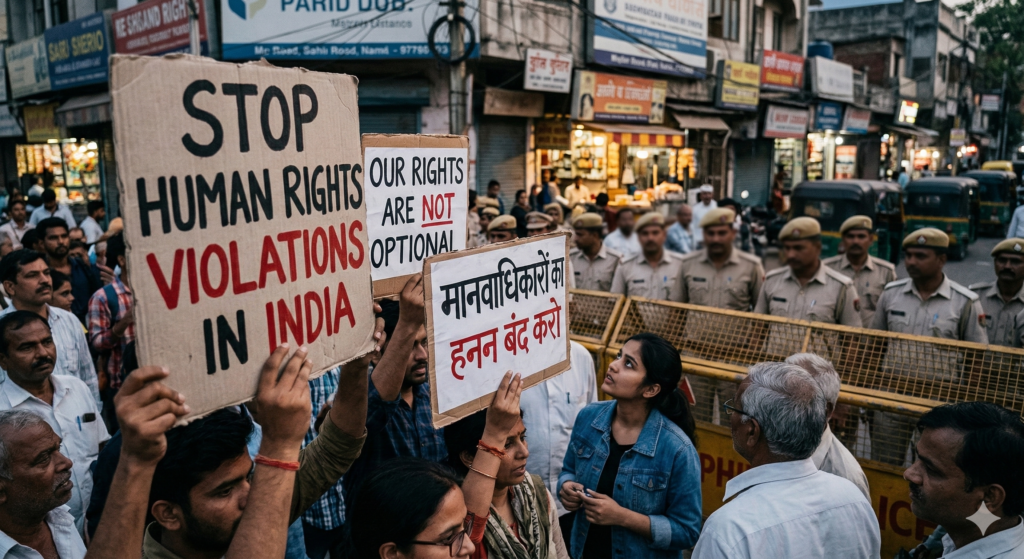
To be a protector and defender of human rights, one must actively participate in treating every individual humanely and with respect regardless of their social, political, economic etc. background. Violation of human rights constitutes denying the moral entitlements of an individual. Moreover, this disregard can be interpreted in some ways as treating individual (s) “less than” or inferior to other members of the society’s respect and compassion. Forms of human rights violations range from genocide, slavery, racism, inhumane medical and biological experiments to honor killing, dowry death and rape. International law is implemented through agencies like the UN to monitor the activities of states and limit the possibility of its plenary power in order to prevent violations against humanity.
Despite the existence of many such laws, there still persists an abundant amount of cases in which human rights are violently violated such as The George Floyd case (2020) to more locally The Madhu murder case (2018). The commonality in all such cases results in the existence of supremacists or power monopolizers who constantly seek the need to be dominating in terms of their ideologies, traditions, practices, customs and beliefs.
In the Indian context, there exists a much more complex system of violations against human rights due to the social structuring of the country. This structure comprises the detrimental presence of Caste system, extensive religious conflict, enduring impacts of uninterrupted invasions, patriarchal oppressions etc.
Among the world’s oldest social structures, the Indian caste system stays enduring and at the forefront of Indian society. The Caste system contains a hierarchical structure that is formed on the principles of purity culture, endogamy, heredity, social segregation and economic control. This millennia old system has lost much of its visibility in urban and modern contexts in post-independent India.
Its structuring included a hierarchical system containing Brahmins at the top who were the priests, teachers and scholars. Then came the Kshatriyas who were the rulers, soldiers and commanders followed by the Vaishyas who were the merchants, traders, cultivators, farmers and bankers. Next accompanied by the Shudras who were the laborers and the service providers like craftsmen, artisan, carpenter etc. Lastly, at the bottom of the hierarchy were the Dalits who were usually required to take up jobs considered to be too filthy to be done by anyone else to such an extent that they were even placed outside the four main varnas.
The treatment and rules placed on the Dalits were exceptionally different compared to other castes with the practice of untouchability being prominent. This practice considered every Dalit to be “impure” and “polluting” which prohibited them to be in any form of contact with every other “higher” caste. Without a doubt, there are variations on how the caste system presented itself from region to region but the above mentioned hierarchy was considered to be more rigid and commonly recognized as well as accepted.
Despite the legal prohibition of untouchability under Article 17 of the Constitution of India, it proceeds to be visible in rural areas and subdued but far from eradicated in urban societies. Caste system in rural societies holds visibility through its local governance in which social components such as distribution of resources, access to healthcare and education etc. are impacted. Political powers abuse the caste system to get a leverage in garnering votes in these rural settings. Although, to a large extent these elected powers ultimately form emphasis on the development, security and appeasing the personal desires of the upper caste families instead of the uniform accountability for its constituency.
The spatial arrangement found in villages and other rural settlements also illustrates the caste hierarchy where Brahmin families tend to reside in areas closer to temples or elevated parts of the village while Dalit families are often to be found in segregated settlements that are physically and socially separate from the central and administrative parts of the village. The discrimination continues into public spaces such as temples, schools, markets etc. where even the access to share communal water sources are denied.
The agrarian rural structure in India serves as strong evidence of the caste visibility in which historically Upper caste landlords own majority of the agricultural lands while lower caste groups tend to be landless laborers, marginal farmers, tenant farmers etc. While there have been various challenges and changes made to this unequal discriminatory system it still prevails to shape the life of millions living in rural India.
Urban centres hold comparatively less visibility of the Caste system however it shouldn’t be inferred that caste has an insignificant effect on modern Indian societies. Their significance stays evident through the recruitment of candidates on the biased or restricted basis of their surnames, construction of separate spaces for lower caste groups in residential areas, marriage alliances made and broken based on caste etc.
Caste even holds its relevance in the Economic standing of an urban citizen which can also be evidently observed. Exclusion also penetrates into the metropolitan rental markets and the corporate settings which limits opportunity, extends discriminatory practices and endangers the safety of lower caste groups. All in all it can be concluded that, caste continues to hold its existence in modern India and to contravene internationally recognized human rights.
India, as a nation, encompasses a broad spectrum of religious traditions, including Hinduism, Islam, Christianity, Judaism, Buddhism, Sikhism, and others. This diversity in faith also facilitates an environment for large scale religious conflict and disparity. The nation has endured a long history of religious conflict and violence, spanning Sikh–Hindu tensions in Punjab to ongoing Hindu–Muslim disputes.
A fundamental principle evident in these conflicts and acts of violence is that individuals’ basic human rights are infringed upon when others believe their faith holds greater legitimacy or prominence and therefore deserves preferential treatment. It is inherently irrational for individuals to act on the assumption that their faith holds superiority over others. Contemporary society has seen a decline in mutual religious respect. In a nation such as India, where democracy and secularism are constitutionally recognized, mutual respect among religions must be upheld as a core value.
By examining the ongoing Hindu–Muslim conflict as a focal point for understanding human rights violations, it becomes evident that tensions between the two communities are largely exacerbated by third-party manipulation. A predominant form of these manipulations manifests in the rise of identity politics, which is shaped by electoral strategies and struggles over resources during the late 20th century while historical forms of such manipulation were entrenched during British colonial rule in the nineteenth century through the implementation of the “divide and rule” policy.
Following independence, individuals seeking to acquire or retain power recognized that manipulating religious sentiments was one of the most effective means of political mobilization. Religion, as a powerful social force, became a tool for mass influence and political gain. Incidents such as the Babri Masjid demolition and the Gujarat riots illustrate how religious sentiments were weaponized to deepen divisions between two of the country’s dominant religious communities. In the name of religion, thousands have been stripped of their basic human rights, subjected to sexual violence, coercion, and severe humiliation.
In modern India, respect for human rights has progressively weakened as personal, political, and communal interests take precedence over constitutional values. The manipulation of social identities and collective sentiments has contributed to widespread violations that undermine equality, dignity, and justice. Despite the existence of legal safeguards, enforcement often remains inadequate, allowing abuses to persist.
This reality highlights the urgent necessity for a strong, independent, and accountable authority dedicated to the regulation, protection, and enforcement of human rights. Such an institution must function beyond political influence to restore public trust, safeguard vulnerable communities, and uphold the democratic and secular principles upon which India is founded.

Very good article, congrats