
The transformation of marriage in India, when examined through a socio-legal and historical lens, reveals a long trajectory from a static, caste-bound, and geographically constrained institution to a fluid, dynamic, and increasingly individualised system, shaped profoundly by colonial intervention, modernisation, and globalisation. In its pre-colonial form, Indian society refl ected what sociologists term a static society, defined by rigid social hierarchies, minimal mobility, and deeply entrenched norms governing behaviour and relationships. Marriage in such a system functioned as a central regulatory institution, not merely organising family life but reproducing caste, controlling sexuality, and ensuring economic and biological continuity.
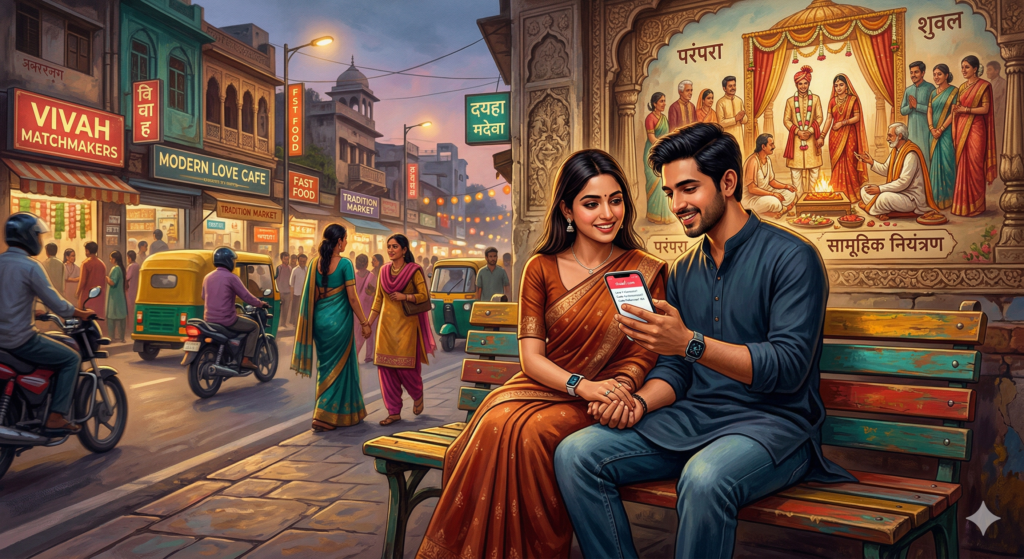
Classical anthropological definitions, such as that of Murdock, conceptualise marriage as involving cohabitation, economic cooperation, and reproduction, while Malinowski’s “principle of legitimacy” emphasises its role in establishing socially recognised parentage . In India, this institution assumed a distinctive form as a sacrament (sanskar), binding not only individuals but families, lineages, and caste groups, thereby embedding marriage within a larger framework of social stratification and cultural continuity . Within this static structure, the caste system operated as the primary determinant of marital choice through the principle of endogamy, defined as marriage within a specific social or caste group to preserve status, purity, and hierarchy .
Empirical studies demonstrate that endogamy has been one of the most resilient features of Indian society, with inter-caste marriages historically remaining extremely low, even in modern times . This rigidity refl ects what may be conceptualised as the “one-time negotiation” nature of traditional marriage, wherein marital arrangements were fixed, irreversible, and collectively decided by families rather than individuals. The absence of divorce and the stigma attached to marital dissolution reinforced the idea of marriage as a permanent and non-negotiable social contract. This rigidity was further reinforced by what may be termed the “constant of geography,” wherein limited mobility and localized social structures ensured that individuals married within confined caste and community networks.
Historical research even suggests that strict endogamy developed and solidified over time as a socio-cultural response to broader political and social changes, including external infl uences and invasions . The economic, biological, and emotional dimensions of marriage in traditional society were deeply intertwined but hierarchically arranged. Economically, marriage functioned as an alliance for the transfer of property, wealth, and status, often mediated through practices such as dowry. Contrary to the assumption that modernisation would eliminate such practices, research indicates that economic growth has in some cases intensified and expanded dowry practices across caste groups, demonstrating the adaptability of traditional institutions .
Biologically, marriage served to regulate reproduction and ensure lineage continuity, aligning with anthropological theories that view marriage as a mechanism for legitimising offspring. However, emotionality remained marginal; marriages were structured around duty, obligation, and social stability rather than personal compatibility or romantic attachment. This resulted in a system characterised by certainty and predictability, where roles and expectations were clearly defined, albeit at the expense of individual autonomy and emotional fulfilment. The advent of colonialism marked a critical turning point in the evolution of marriage in India. British colonial rule introduced processes of legal codification, administrative standardisation, and Western education, which collectively reshaped traditional institutions. The codification of personal laws transformed fl exible customary practices into rigid legal categories, often reinforcing and institutionalising caste and patriarchal norms. At the same time, colonial reforms addressing practices such as child marriage and widow remarriage initiated a gradual shift toward recognising individual rights within the marital framework. Scholars note that the broader process of social change in India, particularly in relation to marriage, accelerated significantly during and after colonial rule due to the combined effects of Western education, urbanisation, and industrialisation . Thus, colonialism functioned both as a force of disruption and as a catalyst for modernisation, setting the stage for subsequent transformations in marital norms.
In the post-colonial and globalised era, Indian society has increasingly exhibited the characteristics of a fl uid society, defined by mobility, fl exibility, and the erosion of rigid social boundaries. Urbanisation, migration, and education have expanded the scope of social interaction, weakening the traditional constraints imposed by caste and geography. Contemporary research highlights that marriage in urban India is now characterised by a process of negotiation between tradition and individual preference, rather than strict adherence to customary norms . The emergence of “self-arranged” and “love-cum-arranged” marriages refl ects this transition, indicating that while family involvement remains significant, individual agency is increasingly recognised . Modernisation theory further supports this
shift, suggesting that economic development leads to later marriages, greater partner choice, and the rise of nuclear family structures . A defining feature of this fl uid society is the increasing centrality of emotionality in relationships, marking a shift from duty-based unions to partnerships grounded in love, compatibility, and personal fulfilment.
Global cultural infl uences, media representations, and technological advancements have played a significant role in redefining expectations surrounding intimacy and relationships. This has led to the emergence of “alternatives to the traditional checkers of marriage,” including live-in relationships, delayed marriages, and non-marital partnerships, which challenge the exclusivity of marriage as the sole legitimate form of union. Sociological debates on the definition of marriage underscore the growing diversity of relational forms and the difficulty of formulating a universal definition that encompasses these variations . However, the transition from a static to a fl uid society has also generated significant tensions and negative externalities. The coexistence of traditional norms and modern values has led to marginalisation of individuals who deviate from established practices, particularly in cases of inter-caste or inter-religious marriages. Despite legal recognition of the right to choose one’s partner, social resistance persists, often manifesting in forms of exclusion, familial opposition, and even violence. The persistence of caste endogamy and the relatively low rate of inter-caste marriages illustrate the enduring infl uence of traditional structures within a modernising society . At the same time, the emergence of a competitive “marriage market,” infl uenced by education, income, and social status, refl ects the increasing role of economic rationality and individual choice in marital decisions. The transformation of marriage has also been accompanied by an increase in emotional disruption, instability, and changing family dynamics. While traditional systems offered certainty and stability, modern relationships are often characterised by uncertainty, negotiation, and emotional volatility. Rising divorce rates, changing gender roles, and the shift toward nuclear family structures refl ect these broader societal changes. Comparative perspectives suggest that while Western societies have long emphasised individualism and emotional fulfilment in marriage, the Indian experience represents a process of cultural hybridisation, wherein traditional and modern elements coexist and interact. This hybrid nature is evident in the persistence of arranged marriages alongside the growing acceptance of romantic relationships, as well as in the continued importance of family approval within an increasingly individualised framework.
The interplay between economic, biological, and emotional factors continues to shape the evolution of marriage in complex ways. Economic considerations remain central, infl uencing partner selection and marital arrangements, while biological imperatives related to reproduction and lineage persist as underlying factors. At the same time, emotional expectations have become increasingly significant, transforming marriage into a site of personal fulfilment and self-expression. This multidimensional nature of marriage underscores the inadequacy of single-factor explanations and highlights the need for an integrated socio-legal approach to understanding its evolution. In conclusion, the institution of marriage in India has undergone a profound transformation from a static, caste-regulated, and geographically constrained system to a fl uid, dynamic, and individualised framework shaped by globalisation, modernisation, and legal development. The concepts of one-time negotiation, constant geography, and caste-based endogamy have gradually given way to ongoing negotiation, spatial mobility, and diverse relational forms. However, this transformation remains incomplete and contested, as traditional structures continue to coexist with and adapt to modern infl uences. The resulting tension between certainty and instability, tradition and modernity, and collective control and individual autonomy defines the contemporary landscape of marriage in India, making it a critical site for understanding broader processes of social change.