
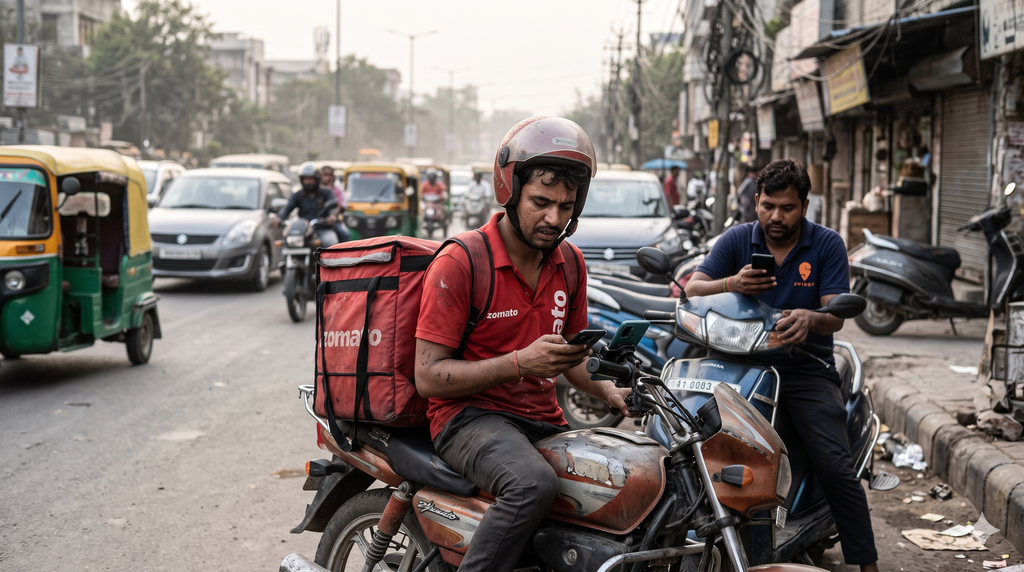
In today’s fast-changing world, the idea of work itself is evolving. One of the most noticeable changes is the rise of the gig economy. The gig economy refers to a system where individuals engage in short-term, flexible jobs instead of traditional full-time employment. These jobs are usually facilitated through digital platforms such as Zomato, Uber, Swiggy, and Ola, as well as freelancing platforms where services are offered on demand. Workers in this system are often referred to as “independent contractors”, which means they are not formally employed by the companies they work for (Kalleberg, 2018).At first glance, gig work appears attractive and empowering. It promises flexibility, independence, and the freedom to choose when and how much to work. For many people, especially students and young workers, this seems like an ideal arrangement. It allows them to earn money without being tied to strict schedules or workplace rules. However, this flexibility often exists more in theory than in practice. Many gig workers find themselves working long hours, chasing peak-time demand, and constantly worrying about their income. Studies on digital labour platforms also highlight how workers adjust their schedules based on demand rather than true choice (Wood et al., 2019).
The rapid growth of the gig economy is closely linked to technological advancements and changing economic conditions. The widespread use of smartphones and internet connectivity has made it easier for companies to connect customers with workers instantly. At the same time, limited availability of stable jobs has pushed many individuals towards gig work as an alternative source of income. Companies also benefit from this model because they can reduce costs related to salaries, benefits, and long-term commitments (De Stefano, 2016).
Although the gig economy appears to be a modern development, its underlying issues are not entirely new. As has been observed in sociological discussions, Gig economy appears modern, but its problems reflect classical sociological concerns. The ideas of Karl Marx and Émile Durkheim, developed in a completely different time, still provide powerful tools to understand the realities faced by gig workers today.The ideas of Karl Marx, particularly his analysis of capitalism, labour, and class relations, remain highly relevant in understanding the gig economy. Even though Marx wrote during the industrial revolution, the patterns he identified can be clearly seen in today’s digital labour systems.
Marx argued that in a capitalist system, workers are often exploited because they are paid less than the value they produce. This concept becomes very visible in the gig economy. Platforms generate large profits by connecting customers and workers, but the workers themselves receive only a fraction of that value.For instance, a delivery worker may complete multiple orders in difficult conditionsnavigating traffic, weather, and time pressureyet the earnings per order remain relatively low. At the same time, the platform continues to grow and expand. This imbalance reflects what Marx described as the extraction of surplus value, where the benefit of labour is disproportionately captured by those who control the system (Scholz, 2017).
What makes this form of exploitation more complex is that it is not always visible. Since gig workers are labeled as “independent,” the relationship appears voluntary. However, in realityworkers have limited bargaining power and must accept the terms set by the platform.
Another important idea of Marx is that workers do not own the means of production. In the gig economy, the “means of production” are not factories or machines, but digital platforms, algorithms, and customer networks. These are entirely controlled by companies.Gig workers depend on these platforms to access work. They cannot independently reach customers at the same scale. Even pricing, order allocation, and visibility are controlled by algorithms designed by the platform. This creates a situation where workers are technically independent but practically dependent (De Stefano, 2016).
In this sense, gig work creates an illusion of freedom while maintaining a structure of control. The worker appears to be self-employed but does not have real autonomy over their work conditions.
Marx also introduced the concept of alienation, which refers to the disconnection workers feel from their work, the product of their labour, and society. In the gig economy, alienation takes on a modern form.Gig workers often perform repetitive, task-based work without any long-term engagement or sense of achievement. A driver or delivery worker may interact with dozens of customers in a day, but these interactions are brief and impersonal. There is no lasting connection or recognition.Moreover, the presence of algorithms as a form of control adds to this alienation. Workers are guided not by humansupervisors but by automated systems that track performance, assign tasks, and determine earnings. As a result, the worker becomes part of a system they do not fully understand or control (Wood et al., 2019).
Thus, from a Marxist perspective, the gig economy represents a continuation of capitalist exploitation in a new, digital form.
While Marx helps us understand the economic structure of gig work, Émile Durkheim provides insight into its social and emotional impact. Durkheim emphasized the importance of social integration, shared norms, and collective belonging in maintaining a stable society.
One of the most noticeable aspects of gig work is the lack of social interaction. Unlike traditional workplaces where employees work together and build relationships, gig workers often operate alone.A freelance worker may spend hours working from home without interacting with colleagues. Similarly, a delivery worker or driver may spend the entire day on the road, interacting only briefly with customers. This limited social contact can lead to feelings of loneliness and detachment.
Durkheim believed that regular social interaction is essential for an individual’s well-being. Without it, individuals may feel disconnected from society, which can affect their mental health (Durkheim,2002).
In addition to isolation, gig workers often lack a sense of belonging. In traditional employment, workers are part of an organization where they share goals, values, and identity. However, gig workers are not considered part of the company, they are simply service providers.
This absence of belonging can reduce motivation and emotional satisfaction. Workers may feel that their contributions are not recognized or valued. Over time, this can lead to a sense of invisibility within the system (Kalleberg, 2018).
Durkheim’s concept of anomie is particularly relevant in the gig economy. Anomie refers to a state of normlessness, where individuals feel uncertain about expectations and lack clear guidance.Gig workersfrequently face changing rules, fluctuating incomes, and unpredictable work patterns. For example, sudden changes in payment structures or rating systems can directly impact their earnings. These changes are often introduced without explanation or consultation.
This unpredictability creates stress and insecurity, making it difficult for workers to plan their lives. In this way, the gig economy reflects a modern form of anomie, where individuals struggle to find stability in a rapidly changing system (Wood et al., 2019).
In my opinion, gig work presents a complex reality that cannot be categorized as purely positive or negative. It offers genuine opportunities but also creates significant challenges that cannot be ignored.On one hand, gig work provides a level of flexibility that is not available in traditional jobs. It allows individuals to manage their time according to their personal needs. For students, part-time workers, and those seeking additional income, this flexibility can be highly beneficial. It also opens opportunities for people who may not have access to formal employment.
However, this flexibility often comes with hidden pressures. Workers may feel compelled to work during peak hours, accept every task, and maintain high ratings in order to sustain their income. In such situations, flexibility becomes less of a choice and more of a necessity.Gig work looks like freedom from the outside, but from within, it often feels like a constant balancing act between earning enough and staying available. The absence of job security, fixed income, and social protection makes this form of work uncertain and stressful.
I believe that gig work should not replace traditional employment but should exist alongside it with proper safeguards. Companies must take responsibility for the workers who contribute to their success, and governments should introduce policies that ensure fair wages, social security, and basic rights.Only then can gig work truly become a fair and sustainable form of employment.
A relatable example of gig work can be seen in the daily lives of food delivery workers associated with platforms like Zomato and Swiggy.A typical day for a delivery worker often begins by logging into the app and waiting for orders. While the system suggests flexibility, workers quickly realize that earning a decent income depends on being active during peak hours, such as lunch and dinner times. This means that their schedules are indirectly controlled by demand rather than personal choice.Throughout the day, the worker travels across the city, navigating traffic, weather conditions, and time pressure. In many cases, they skip meals or rest breaks in order to complete more deliveries. The more orders they complete, the higher their earningsbut this also leads to physical exhaustion.
Income in this system is highly unpredictable. On some days, a worker may receive a steady flow of orders, while on others, there may be long waiting periods with no work. Incentives and bonuses may exist, but they often come with strict conditions that are difficult to meet.
Another major challenge is the lack of job security. If a worker falls sick, faces an accident, or is unable to work, there is no guaranteed income or support system. This makes gig work financially risky, especially for those who depend on it as their primary source of income.
One of the most stressful aspects of the job is the rating system. Customer ratings directly influence a worker’s future opportunities. A few negative reviewssometimes due to reasons beyond the worker’s control, such as traffic delays or restaurant errorscan reduce their chances of receiving orders.
By the end of the day, a worker may have spent several hours on the road, completed numerous deliveries, and still feel uncertain about their earnings. This everyday reality highlights the gap between the promise of flexibility and the experience of instability in gig work (Wood et al., 2019).
The gig economy is undoubtedly shaping the future of work. It offers flexibility, accessibility, and new opportunities for earning income. However, it also brings significant challenges related to job security, worker rights, and social well-being.As seen through the perspectives of Karl Marx and Émile Durkheim, the issues faced by gig workers are not entirely new. They reflect deeper structural and social concerns that have existed in different forms throughout history.
If the gig economy continues to grow without proper regulation, it risks creating a workforce that is flexible but vulnerable. Therefore, it is essential to strike a balance between innovation and protection.Governments should introduce policies that ensure fair wages, social security, and legal recognition for gig workers. Companies should move beyond viewing workers as temporary resources and acknowledge their role as essential contributors. In the end, the future of gig work will depend on how well society addresses these challenges. Flexibility should not come at the cost of dignity, stability, and basic rights. Only by addressing these concerns can the gig economy become a truly sustainable and equitable system.
