
The answer to caste discrimination in elite institutions cannot be the physical separation of students by caste. That would transform a social stigma into an institutional identity.
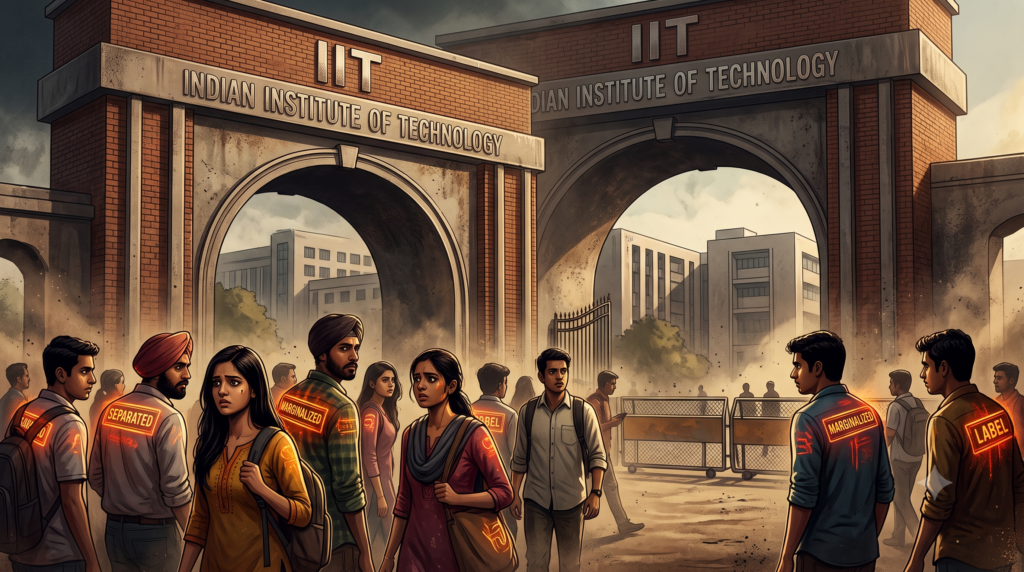
“Let us study alone, so that we face no allegations.” In essence, that is the proposition contained in a graphic circulating on social media in the aftermath of the death of Sahil Wakode, a second-year B.Tech student at IIT Bombay. The graphic, described as a “simplified paraphrase” of an unnamed argument, proposes that IITs be distributed according to reservation categories, with some institutions largely accommodating reserved-category students and others the general category. It is not a government proposal. Yet the sentiment behind it deserves serious attention because it emerges from a deeper crisis of trust: the fear that entering an elite institution through reservation can expose a student not merely to academic pressure, but to the social burden of having to repeatedly prove that he or she belongs.
Wakode, a Scheduled Caste student, died by suicide on September 18. His family has alleged caste-based discrimination and harassment, and the National Commission for Scheduled Castes has undertaken a spot inquiry. The Mumbai Crime Branch has also recorded statements as part of the investigation. IIT Bombay has disputed portions of the family’s account. These allegations must remain allegations until established through due process. But the institutional question they raise is larger than any individual case: how should India’s premier educational institutions respond when caste enters the classroom not as a constitutional category but as a source of stigma, suspicion and social distance?
The proposal to create separate IITs according to reservation categories offers an apparently simple answer to an extraordinarily complicated sociological problem. It is also the wrong answer.
The arithmetic itself is revealing. India’s reservation framework provides 15 per cent of seats for Scheduled Castes, 7.5 per cent for Scheduled Tribes, 27 per cent for Other Backward Classes and 10 per cent for Economically Weaker Sections, subject to the applicable rules. Applied mechanically to 23 IITs, these percentages do not even produce whole institutions: approximately 3.45 IITs for the SC share, 1.73 for the ST share and 2.3 for EWS. More importantly, the categories cannot simply be converted into institutional boundaries because candidates belonging to reserved communities can also secure Open seats on the basis of rank. The Open category is not a synonym for “upper caste”, just as a reserved category is not a synonym for “less meritorious”. To physically divide IITs according to these categories would therefore impose a rigid institutional geography on a considerably more fluid admissions system.
There is also a material question that cannot be ignored. Recent official data reported that 4,804 of 12,498 sanctioned faculty positions across the 23 IITs were vacant as of January 30, 2026 — a vacancy rate of 38.4 per cent. At a time when India’s premier technical institutions are already confronting shortages of academic manpower, further institutional fragmentation would raise questions about faculty concentration, research infrastructure and academic capacity. But these are the easier objections. The deeper objection is sociological.
A rank is a selection device, not a biography. It records performance in an examination; it does not record the social circumstances in which that performance was produced. It does not tell us whether a student attended an elite school or a poorly resourced government school, whether private coaching was affordable, whether English was the language spoken at home, whether parents understood the architecture of competitive examinations, or whether the family had ever encountered an institution of higher education before. Pierre Bourdieu’s concepts of cultural capital and social capital remain especially useful here. Educational institutions reward not only formal knowledge but also familiarity with institutional language, expectations, networks and practices. Students do not enter elite universities with identical stocks of these resources.
My own census-and-referral study of 200 Scheduled Caste doctors and faculty members in three Punjab government medical colleges, based on data collected in 2022, illustrates this point. In the sample, 98.5 per cent were first-generation doctors and none had a doctor as a parent. Only 37.5 per cent had joined coaching for the entrance examination, while 55 per cent had not, citing cost, accessibility and lack of guidance. These findings should not be interpreted as evidence of lower ability or higher ability. They reveal something more fundamental: merit is produced within unequal social conditions.
This is where the sociology of education becomes indispensable to the debate on reservation. If merit is treated as an entirely individual achievement, then every difference in educational outcome can be attributed to individual ability. But if achievement is understood within its social context, we see that opportunity, family background, schooling, language, networks and institutional familiarity also influence educational trajectories. Reservation, therefore, is not simply an alternative route into an institution. It is one mechanism through which a society attempts to compensate, however imperfectly, for historically unequal access to educational and social capital.
The more disturbing issue begins after admission.
A student may enter IIT through a reserved category, but the category can continue to follow the student long after the entrance examination has ended. Two students receive the same poor grade. One sees it as evidence that the course was difficult. The other, conscious that classmates know the category through which he or she entered, may interpret the same grade differently: perhaps I do not belong here. This is where Charles Horton Cooley’s concept of the looking-glass self becomes relevant. Our self-image is partly constructed through our perception of how others perceive us. Erving Goffman’s theory of stigma takes the argument further: a socially discredited identity can become the lens through which an individual’s otherwise unrelated behaviour is interpreted.
The result is a particularly insidious form of inequality. A poor examination score is no longer merely an academic event. It can become “proof” of presumed inadequacy. A student’s hesitation can become evidence of incompetence. A disagreement can be attributed to entitlement. An ordinary academic failure can acquire a caste meaning. This is how stereotypes reproduce themselves through everyday interaction.
My study provides disturbing evidence of precisely such processes. Sixty-one per cent of respondents reported discriminatory behaviour from classmates during their MBBS education, while another 16 per cent said such behaviour occurred sometimes. Sixty-three per cent reported that everyday differential treatment lowered their self-esteem. Forty-eight per cent said discrimination affected their mental health, with another 28 per cent reporting such effects sometimes. Fifty-two per cent said they had concealed their caste at the workplace. One respondent recalled being labelled “Sarkari Damad” — the government’s son-in-law — simply for occupying a reserved seat.
The expression is sociologically significant. It transforms a constitutional mechanism intended to address historical exclusion into a supposed personal favour. The student is no longer evaluated solely as a student. He or she becomes a “quota student”. Once this label becomes socially available, every subsequent achievement can be discounted and every failure can be attributed to the category.
This is what sociologists call labelling: an externally imposed social identity begins to shape the way an individual is perceived and, eventually, how the individual may perceive the self. Robert K. Merton’s work on self-fulfilling prophecies also offers a useful conceptual lens. When expectations about a group become sufficiently entrenched, social behaviour can begin to reproduce the conditions that appear to confirm those expectations. The danger is not merely discrimination by an individual. It is the creation of an institutional culture in which a stereotype becomes normalised.
Recent Indian data suggest that the problem cannot simply be dismissed as an accumulation of isolated incidents. UGC data submitted to a Parliamentary Standing Committee showed that reported complaints of caste discrimination in higher educational institutions increased from 173 in 2019-20 to 378 in 2023-24. These figures should be interpreted cautiously: increased reporting may also reflect greater awareness and improved reporting mechanisms. They nevertheless demonstrate that caste-based discrimination remains a live institutional concern within Indian higher education.
At the same time, the expansion of access should not be overlooked. According to the latest All India Survey on Higher Education data, SC enrolment in higher education reached 69.72 lakh in 2023-24, compared with 46.07 lakh in 2014-15. ST enrolment rose from 16.41 lakh to 28.83 lakh during the same period, while OBC enrolment reached approximately 1.80 crore. These figures represent an important transformation of Indian higher education. More young people from communities historically excluded from elite educational spaces are entering universities and professional institutions.
But access is only the first stage of inclusion.
The sociology of institutions teaches us that formal entry does not automatically produce substantive belonging. An institution can be legally open while remaining socially unequal. A student can possess the same admission letter, sit in the same classroom and take the same examination, yet experience the institution differently because of caste, class, language, gender or family background.
This distinction between formal equality and substantive equality lies close to the heart of B.R. Ambedkar’s thought. Political democracy cannot remain secure if social relations continue to be structured by graded inequality. Ambedkar’s warning about the contradiction between political equality and social inequality remains particularly relevant to universities. The question is not simply whether a Dalit student is legally permitted to enter an IIT. The more difficult question is whether, after entering, the student is treated as an intellectual equal.
That is why segregation is such a dangerous response.
If reserved-category students were concentrated in particular IITs, the institutions themselves could acquire a caste identity. The social imagination could begin to produce distinctions between the “real IITs” and the “reserved IITs”. Students entering the latter would inherit an institutional label before they had written their first examination. The very policy intended to protect them from stigma could create a new and more durable form of stigma.
This is the paradox of segregation: it can convert a social prejudice into an institutional identity.
International human-rights frameworks provide a useful comparative perspective. United Nations human-rights mechanisms have repeatedly treated discrimination based on descent, including caste and analogous systems of inherited status, as a form of structural discrimination requiring institutional remedies. The broader international experience with racial, ethnic and descent-based segregation also demonstrates why separation is a poor substitute for equality. Whether the context is caste in South Asia, race in the United States or apartheid in South Africa, physical separation has historically tended to institutionalise hierarchy rather than dissolve it.
India’s challenge is therefore not to make caste invisible. It is to prevent caste from becoming destiny.
The IITs need stronger and more credible anti-discrimination systems, independent grievance mechanisms, transparent investigations, meaningful representation, faculty sensitisation and sustained mentoring for first-generation students. Mental-health services must also be strengthened, but counselling cannot become a substitute for institutional reform. If a student’s distress is partly produced by humiliation, exclusion or discrimination, telling the student merely to “cope better” individualises what may actually be an institutional problem.
Faculty diversity matters as well. Representation should not be reduced to symbolic arithmetic. Teachers influence classroom cultures, mentoring relationships, research networks and students’ sense of intellectual belonging. A student who sees people from historically excluded communities occupying positions of academic authority receives a powerful message about what kinds of lives are institutionally imaginable.
The same principle applies to student life. Hostels, student societies, peer groups and informal academic networks can reproduce hierarchies just as effectively as formal rules. Caste discrimination does not always announce itself through explicit slurs. It can appear through social exclusion, jokes, assumptions about merit, differential expectations, reluctance to collaborate, or the persistent curiosity about “which category” someone belongs to.
The institutional response must therefore be sociological rather than merely punitive. The objective should not simply be to identify and punish spectacular incidents. It should be to alter the everyday culture in which such incidents become possible.
Reservation itself should not be reduced to a binary contest between “merit” and “quota”. Such a formulation is sociologically impoverished. The relevant question is what we mean by merit in a society where educational opportunities have historically been unequally distributed. A rank is real. Academic ability is real. Competition is real. But so are inherited inequalities in schooling, resources, social networks and institutional familiarity.
To acknowledge these inequalities is not to deny merit. It is to place merit in its social context.
The tragedy surrounding Sahil Wakode should therefore not become an occasion for constructing another hierarchy between students. Nor should it be used to prejudge an ongoing investigation. It should compel India’s elite institutions to examine the social environment in which their students study, compete and live.
The answer to caste discrimination cannot be caste segregation. The answer to stigma cannot be separation. And the answer to a student being marked by caste cannot be to build an institution whose very identity marks its students by caste.
The purpose of reservation is not to create a permanent class of “reserved students”. It is to make historically unequal access less unequal. The ultimate measure of its success should therefore be a society in which the category through which a student entered an institution becomes progressively less socially significant than what the student does after entering it.
India does not need IITs divided by caste. It needs IITs capable of confronting caste.
The objective should be neither a naïve caste-blindness that refuses to acknowledge structural inequality nor a caste-conscious segregation that reproduces it institutionally. It should be a more difficult form of equality: an educational system in which caste matters enough to understand inequality, but not enough to determine belonging.
That is the standard to which India’s premier institutions should be held.
Dr. Bawa Karwal, Assistant Professor, UILAH (University Institute of Liberal Arts and Humanities), Chandigarh University, Mohali (India)
ORCID ID: 0000-0002-7747-3880