
In the annals of urban failure, December 2025 will stand as a grim milestone for India’s capital. For four harrowing days between December 13 and 16, New Delhi did not merely experience “poor air”; it underwent a systemic atmospheric collapse. As the Air Quality Index (AQI) breached the ceiling of standard measurement, peaking at a suffocating 498, the city was transformed into what medical professionals unhesitatingly called a “gas chamber.”
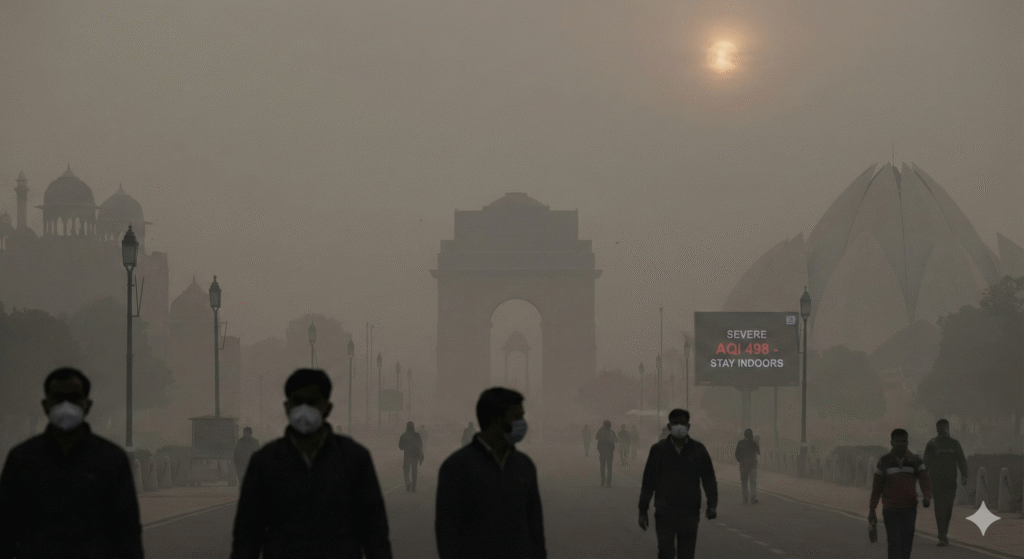
But the grey apocalypse of December 2025 was not just a meteorological disaster; it was a sociopolitical revelation. It stripped bare the hollowness of our technological interventions, the deceit in our data, and the brutal “environmental apartheid” that now defines urban life in the National Capital Region (NCR).
The Mirage of Data
For months leading up to this crisis, the government fed the public a diet of optimism. Citing satellite data, officials claimed a 90% reduction in farm fires in Punjab and Haryana. If the data was correct, the skies should have been blue. They were not.
The crisis exposed a catastrophic “systemic blind spot.” As reports from iFOREST and satellite analyses now reveal, the fires didn’t vanish; they merely went dark. Farmers, displaying a shrewd understanding of surveillance technology, shifted their burning schedules to late afternoon (after 3:00 PM), effectively evading the midday pass of NASA’s polar-orbiting satellites.
We celebrated a statistical victory while the “burnt area” on the ground reduced by only a fraction of the claimed numbers. By relying on intermittent snapshots rather than continuous geostationary monitoring, the state allowed itself to be blindsided. The smoke, released in the evening, traveled overnight to arrive in Delhi exactly as the morning temperature inversion clamped a lid over the city.
The Physics of the Trap
We must stop acting surprised by geography. Delhi sits in a landlocked bowl. In winter, as ground temperatures drop and winds stall, this bowl becomes a trap.
When the “ventilation index” collapses—as it did last week—pollutants from transport, construction, and biomass burning have nowhere to go. They spread horizontally, creating a toxic feedback loop where smog thickens fog, and fog chemically intensifies smog. This is simple physics. Yet, our response remains stubbornly reactive, relying on emergency bans (GRAP) that tackle the symptoms while ignoring the chronic disease.
Environmental Apartheid
Perhaps the most disturbing aspect of this crisis was the clarity with which it drew the lines of class. December 2025 solidified the concept of “smog refugees.” The affluent fled to Goa or retreated into air-purified fortresses, turning their homes into “clean air bubbles.”
Meanwhile, the working class became the city’s human filters. Gig workers, delivering food to those sealed in high-rises, rode through the toxic soup with little more than handkerchiefs for protection. Construction bans, intended to save lungs, instead starved stomachs, stripping daily wagers of their income precisely when their medical costs for respiratory distress were spiking. We have created a city where the fundamental act of breathing is now a luxury good, indexed to one’s net worth.
The Theater of Failure
The administrative response moved from tragedy to farce. The Connaught Place Smog Tower, a ₹20 crore monument to scientific illiteracy, stood locked and defunct during the peak of the crisis, its staff unpaid. The promises of “cloud seeding” evaporated against the reality of dry winter skies.
But the most damning indictment came not from the courts, but from the street. When Lionel Messi, the world’s most popular athlete, took the stage at the Arun Jaitley Stadium, he was not met with adulation, but with desperate chants of “AQI, AQI.” When the youth of a nation scream pollution metrics at a football god, it signals that the patience of the citizenry has finally snapped. The pollution crisis has transcended environmental concern to become a visceral source of political rage.
The Way Forward
The gasp for air in December 2025 must be treated as a final warning. The era of band-aid solutions, smog towers, anti-smog guns, and cosmetic bans is over.
We need a unified “airshed management” authority that overrides state borders, acknowledging that pollution does not stop at a toll booth. We need data integrity that uses geostationary satellites to track the real burnt area, not just the convenient fires. And above all, we need to acknowledge that as long as Delhi relies on private transport and diesel-guzzling industry, it will continue to choke on its own exhaust.
The “grey apocalypse” was an inevitability born of negligence. If we do not treat clean air as a non-negotiable human right, the silence of the upcoming winters will be broken only by the sound of a city wheezing.