
In early December, the Caribbean transformed from a zone of holiday cruising into a theater of naval warfare. The images released by the U.S. Department of Justice were cinematic: Marines rappelling from helicopters onto the deck of the Skipper, a massive crude carrier, executing a military-style seizure of two million barrels of oil.
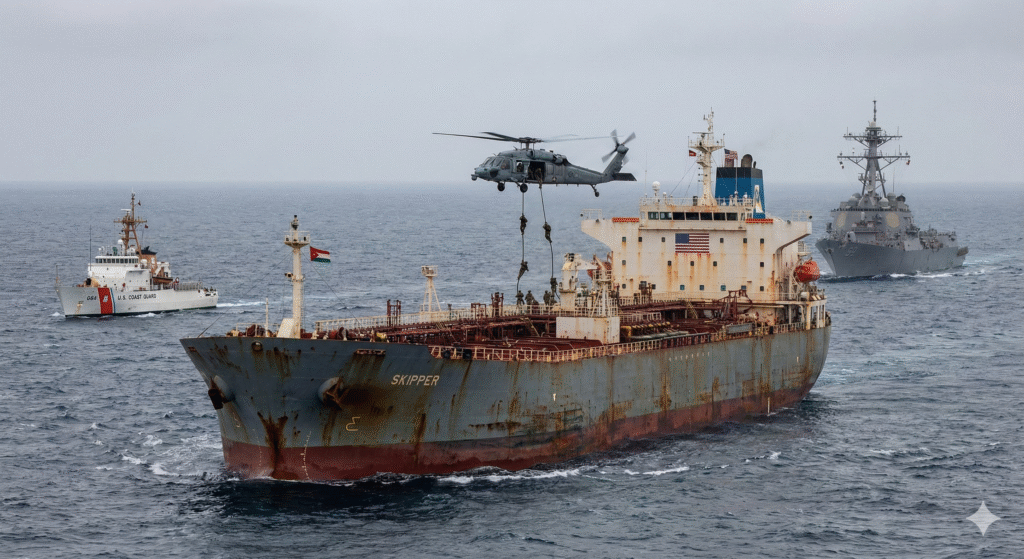
President Donald Trump’s announcement—“We’ve just seized a tanker… I assume we’re going to keep the oil”—marked a dramatic pivot in American foreign policy. We have moved beyond the era of digital sanctions and frozen bank accounts into a new, kinetic phase of “maximum pressure.” This operation, the first known interdiction of Venezuelan crude since 2019, is not merely a law enforcement action; it is a geopolitical gamble that redefines the rules of engagement on the high seas.
The Muscle: From Paper Tigers to Real Marines
For years, sanctions against the Maduro regime were bureaucratic affairs. But the deployment of the USS Gerald R. Ford carrier strike group and a campaign of over 20 airstrikes on suspected narco-trafficking vessels signals that Washington is no longer content with economic strangulation alone. The administration’s logic is blunt: if the oil funds “narcoterrorism,” the U.S. will physically take it.
This militarization has immediate consequences. The Skipper operation effectively caps months of build-up in the southern Caribbean. While the White House frames this as strict enforcement against a “rogue regime,” the lethality of recent operations—with over 80 reported fatalities in related interdictions—raises profound questions about the proportionality and legality of this new naval siege.
The “Shadow Fleet” and the Legal Grey Zone
The central controversy of the seizure lies in the definition of the vessel itself. Caracas has cried “piracy,” with President Nicolás Maduro dubbing the U.S. forces “Pirates of the Caribbean.” However, the legal reality is far murkier.
U.S. officials argue that the Skipper was not a sovereign Venezuelan vessel but a “stateless” ghost. Maritime trackers revealed the ship was flying a false Guyanese flag and spoofing its location—hallmark tactics of the global “shadow fleet.”
By operating in the shadows to evade sanctions, these vessels inadvertently strip themselves of legal protection. Under the Law of the Sea, a ship with no valid nationality is subject to boarding by any warship. This technicality allows the U.S. to frame the raid not as an act of war against Venezuela, but as a routine policing of a stateless, contraband-carrying hull. Yet, critics warn that this is a slippery slope. As legal scholars note, unilateral sanctions lack UN Security Council authorization. Enforcing them with military boardings may satisfy U.S. domestic courts, but it risks violating the spirit, if not the letter, of the UN Charter.
The Economic Chill: A Shiver in the Market
The seizure has sent a shockwave through the energy sector that outweighs the actual volume of oil involved. While two million barrels is a drop in the global bucket, the psychological impact has been immediate.
Almost overnight, the “shadow trade” froze. Reports indicate that tankers carrying nearly 11 million barrels of Venezuelan crude are now idling offshore, their captains terrified of becoming the next target. The cost of doing business with Caracas has just skyrocketed.
While global oil prices saw only a modest jump (Brent crude rose 0.4%), the long-term implications are volatile. If Washington systematizes these seizures, it doesn’t just tighten supply; it invites chaos. A “cat-and-mouse” game between the U.S. Navy and desperate smugglers increases the risk of oil spills, collisions, and kinetic escalations in international waters.
The Diplomatic Fallout
The seizure has deepened the fractures within Latin America. While Venezuelan opposition figures like Nobel laureate María Corina Machado applauded the move as defunding a repressive machinery, regional leaders are alarmed. Brazil’s President Lula da Silva, breaking a long silence, urged “peace” over brinkmanship, recognizing that a militarized Caribbean is bad for business and stability.
More concerning is the precedent this sets for great-power competition. If the U.S. establishes that it can seize commercial cargo on the high seas based on unilateral sanctions, what stops Beijing or Moscow from applying the same logic to Western vessels in the South China Sea or the Baltic?
A Dangerous Precedent
The boarding of the Skipper was a tactical success but a strategic provocation. It demonstrated that the U.S. can and will reach out to choke the revenue streams of its adversaries. However, by militarizing commercial shipping lanes, the Trump administration is lighting a match near an oil slick.
We are witnessing the return of gunboat diplomacy in the 21st century. While it may temporarily cripple Maduro’s finances, it risks turning the high seas into a lawless frontier where “might makes right.” As the Skipper is towed to a U.S. port to have its cargo liquidated, the world must ask: is this the restoration of order, or the beginning of a new, global maritime conflict?